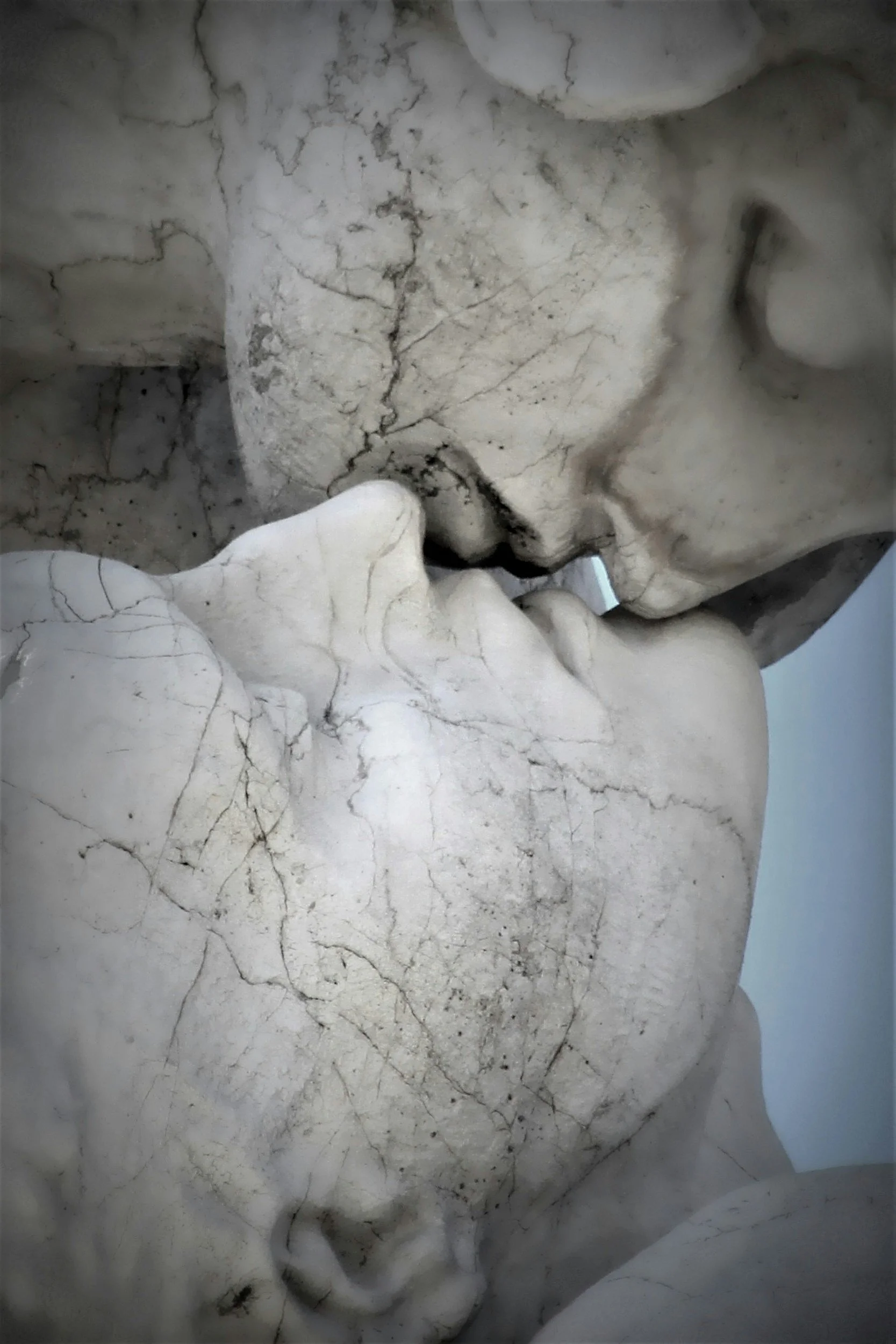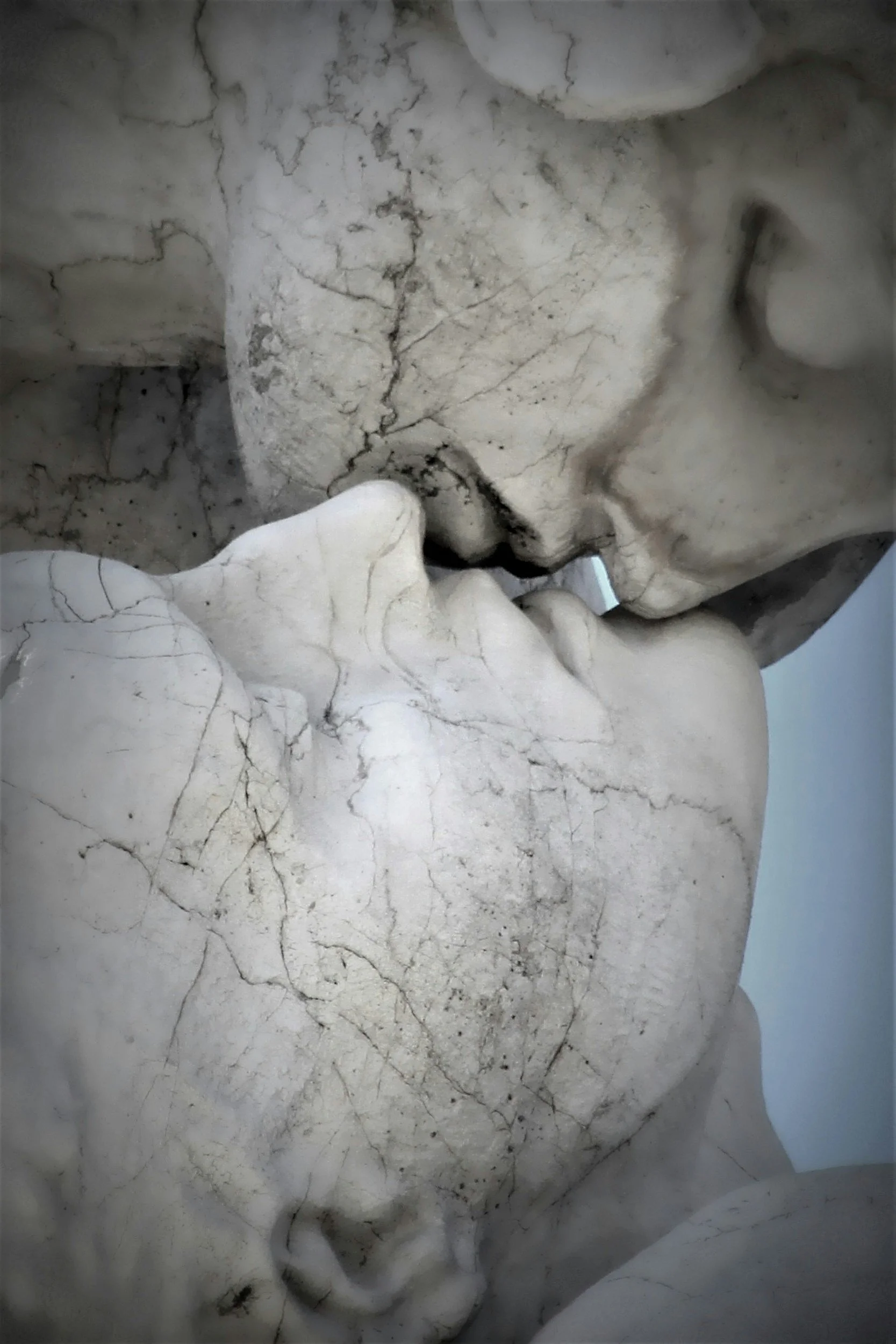
This was the first time Agatha was alone with Phineas.
She stood over him for a moment without touching him, wanting to savor the private strangeness of finally having him to herself. He seemed even more beautiful in silence. Without conversation, without interruption, without the clumsy obligations of ordinary life pressing in on either side of them, there was something almost sacred in being able to look at him as long as she pleased.
Agatha let herself look.
His mouth was slightly open, as if he had just been about to say something. One arm rested beside him at an angle that felt careless, unguarded. He looked like a man caught in pause rather than stillness, as though at any second he might turn his head, find her watching him, and let the corner of his mouth lift in that quiet way she had imagined a hundred times before.
But he didn’t.
That emboldened her.
She stepped closer, her pulse beating harder now, and reached for his hand. She touched him lightly at first, giving him the chance to resist, to pull away, to ruin the fantasy before it had even begun.
He didn’t.
Agatha smiled and drew his fingers against her thigh.
The gesture sent heat rolling through her so quickly she nearly laughed. All this time she had wondered what kind of man he would be—whether he would be hesitant, proud, cruel, gentle. Now she thought perhaps she had known all along. He had the kind of face that made a woman want to confess things. The kind of body that suggested a hidden severity. A restraint. As though whatever he wanted, he wanted it deeply enough not to waste language on it.
She leaned down and kissed him.
It was meant to be a test. A soft one. Just enough to wake the moment between them and see whether it lived.
His lips gave beneath hers with an ease that made her breath catch.
Agatha kissed him again, longer this time, and when his hand slipped from where she had placed it, brushing lower against her leg, she shivered. She caught his wrist and guided him back up, this time higher, pressing his palm where she wanted to be touched.
There, she thought.
There you are.
Her body answered before her mind could. She felt herself soften, open, begin. It had been building toward this for longer than she cared to admit. In glances. In imaginings. In the private violence of wanting something she had never once asked for aloud. She had made a whole world out of almost nothing: the shape of his mouth, the breadth of his shoulders, the possibility of his looking at her and seeing not the woman everyone knew, but the woman who lived beneath her skin. The ravenous one. The lonely one. The one who wanted to be chosen so thoroughly it bordered on annihilation.
Now here he was beneath her hands, and if he would not choose her in words, then perhaps he was choosing her this way.
Agatha lifted his hand to her mouth and kissed each finger slowly. She let her lips linger over the knuckles, the tips, the spaces between them, and when she looked back at him she felt a tightening low in her belly so sharp it almost frightened her. She wanted to make him react. Wanted proof that he was as full of hunger as she was. Wanted to drag something visible from him and know she had done it.
Instead, he stayed beautifully quiet.
That too she mistook for depth.
She moved closer and let her hand travel over him with more confidence now, tracing the planes of him, feeling him yield to her touch in a way that made her bolder. She kissed his neck. His chest. Pressed herself against him as though the nearness alone might bring him fully into the moment. She imagined his restraint thinning by degrees, his body giving itself over piece by piece, his silence not empty but loaded. She had known men who made noise too soon, men who rushed to prove themselves with clumsy enthusiasm. Phineas, she thought, was not like that. Phineas felt like a held breath. Like something dark and concentrated.
Agatha wanted to be the one to break him open.
When she shifted against him, his arm slid and dragged along her side, and the accidental intimacy of it sent a tremor through her. She took hold of him again, more urgently this time, arranging him where she wanted him, telling herself she was only helping him say yes in the language he preferred. Her own breathing had begun to fill the room now. She could hear it—thin at first, then rougher, catching in the back of her throat.
“You wanted this,” she whispered.
Whether she meant him or herself, she did not know.
The sentence dissolved between them.
Agatha kissed him harder, and because he did not interrupt her, because he did not break the spell by speaking or pulling away or revealing himself to be smaller than what she had imagined, desire became something denser than desire. It became permission. It became its own proof. In his quiet she found room for every dangerous invention. She could give him any thought she wanted. Any motive. Any ache. He received all of it without contradiction.
Her hand moved lower. Then lower still.
She felt a wild little thrill at the weight of him, at the pliancy of him beneath her handling, at the way everything in the room seemed to narrow around the place where her body ended and his began. The world outside them had gone irrelevant. There was only the pressure of touch, the sound of her own blood, the mounting heat of being able to take what had so long been unavailable.
She climbed over him slowly, as if crossing into something irreversible.
The air touched more of her now. She did not care. She was beyond embarrassment, beyond caution. Whatever version of herself might once have hesitated had already receded. In its place was a woman moving by instinct alone, by need, by the long-denied pleasure of no longer being denied.
She bent over him and kissed him again, deeper than before, one hand braced beside his head, the other guiding him, fitting him, making the moment become what she required it to be. Her hair slipped around them like a curtain. Her mouth opened over his. Her body moved with growing certainty. She pressed herself down and gasped at the force of feeling that rose through her. It was not tenderness now. Not really. It was something stranger and more consuming than tenderness. Something devotional in shape and feral in practice.
In her mind, he met her there.
In her mind, his stillness was effort—the effort not to lose control too soon.
In her mind, his silence was concentration.
In her mind, every slip of his body beneath hers was an answer.
Agatha rocked harder against him, each motion feeding the next, until she could no longer tell whether she was chasing pleasure or trying to bury herself in it. Her hands gripped him wherever they could. Her mouth found his throat again, then his chest, then his mouth. She wanted to overwhelm him. Wanted to be overwhelming. Wanted to feel him overtaken by her, undone by her, wanted so badly that the wanting itself began to feel holy.
The pressure built inside her in hot, merciless waves.
She clutched at him. Guided his hands where she wanted them. Pressed his palms against her body and held them there, dizzy with the luxury of being able to make everything obey the shape of her need. She moved faster. Harder. The sound that escaped her then was raw enough to startle her, but once it was out she could not call it back. More followed—small, broken sounds, then louder ones, stripped of dignity, stripped of thought.
Phineas stayed beneath her, inscrutable and open.
Agatha mistook that openness for surrender.
The room lost its edges. The air thickened. Time unraveled. There was only the insistence of her body, the unbearable closeness of climax, the vast interior thunder of wanting finally given permission to finish itself. She bowed over him with a cry, every muscle seizing, every part of her drawing tight around the force of release. She rode it all the way through, trembling so hard she thought she might split apart under it.
For a few suspended seconds afterward, she remained draped over him, breathing in ragged bursts, eyes closed, unwilling to reenter the world just yet. Her forehead nearly touched his chest. One hand still pinned his wrist where she had placed it. The other shook against him, too weak to hold itself up.
Then she opened her eyes.
At first she did not understand what had changed.
The room was too quiet.
Not intimate quiet. Not the breathless quiet after pleasure.
A larger quiet than that.
Agatha lifted her head slowly.
The light above her buzzed.
A hard white glare fell over the room and flattened everything beneath it. What a moment ago had felt private now looked exposed. Sharpened. Wrong.
Her gaze dropped to the hand she was still holding against her breast.
Very carefully, as though the motion itself might alter reality, she lifted her fingers away one by one.
His hand slid down and fell with a dull, loose weight against her body.
Agatha froze.
“No,” she whispered.
The word came out before thought.
She stared at him.
His eyes were open, but not with desire, not with daze, not with anything. They were simply open. His mouth, which she had been kissing as though it concealed some terrible softness, hung slightly parted in the same unchanging shape. There was no tension in him, no withheld breath, no aftermath. Only arrangement. Only the awful fact that every answer she had felt from him had come from her.
Agatha jerked backward so fast her knee slipped. She hit the floor hard, the impact jolting through her spine, but she barely felt it. Her gaze flew around the room, seeing it now as if a veil had ripped.
Steel.
Tile.
A drain in the floor.
A tray of instruments overturned nearby.
The wall of drawers.
The antiseptic sting in the air.
The table.
The table.
Above her, Phineas lay sprawled on a metal autopsy slab.
Agatha’s face emptied.
Then horror moved in.
Not the abstract kind. Not the delicate kind. Total, bodily horror. The kind that enters through every opening at once.
She looked back at him and this time she saw what had been there all along and what she had refused to name: the weight of limbs that had not resisted because they could not, the passivity she had romanticized into restraint, the yielding she had called consent, the silence she had filled with longing because the alternative was unthinkable.
A sound tore out of her, half gasp and half moan, except now there was no pleasure in it at all.
“No,” she said again, shaking her head violently. “No, no, no.”
But the room had already become itself.
She could smell it now beneath everything else—the cleaned-over nearness of death. She could see the instruments clearly. The suturing materials. The discarded gloves. The chart she had read earlier. She saw his body not as a man withholding himself but as what it was: a body on a slab, a body entrusted to procedure, a body opened to examination, a body that had already belonged to death before she ever touched it.
Her stomach turned with brutal force.
Agatha lurched to one side and vomited onto the tile.
The convulsions wrung through her again and again until her eyes watered and her throat burned. She knelt there, naked and shaking, one hand braced against the floor, strings of saliva hanging from her mouth, while above her the fluorescent light buzzed on as if nothing at all had happened.
Then she looked at Phineas and fury came.
It came because shame alone was too much to bear.
“Fuck you,” she screamed.
Her voice ricocheted off the steel drawers.
“Fuck you for this.”
She snatched the tray nearest her and hurled it. Instruments crashed and scattered. She stumbled to her feet and struck the drawers with the flat of her hand, then again, harder, then with both fists. The pain barely registered. She wanted noise. She wanted destruction. She wanted something outside herself to hold the ugliness of what had happened.
“I’m not sick,” she shouted, wild-eyed, hoarse. “I’m not sick.”
The words sounded unconvincing even to her.
She hit the drawers again.
This is your fault, she thought, because some part of her still needed someone else to be guilty first.
But even as the thought formed, another one came beneath it, colder and cleaner:
He did nothing.
He had done nothing.
He had not chosen. Had not yielded. Had not wanted. Had not asked. Every bit of life she had poured into him had been hers alone—hers to invent, hers to mistake, hers to force.
Agatha sagged.
The rage burned out almost as suddenly as it had arrived. In its wake came shaking. Then sobbing. Then the thin mechanical scrape of her own breath trying to steady itself enough to survive the next minute.
She stood there a long time, arms wrapped around herself, staring at the body on the slab.
At last the part of her that had built a career where other people would have collapsed came forward.
Training.
Discipline.
Procedure.
She bent and collected her clothes. She dressed with stiff, jerking movements, then stopped, stripped again, and crossed to the hose. She cleaned herself with a frantic precision that bordered on violence, as if she could wash not only the fluids from her skin but the event itself from time. She dried off. Dressed again. Tied her hair back with trembling hands.
Then she got to work.
First the floor.
Then the walls.
Then the tray.
Then the instruments.
She cleaned until the room no longer looked interrupted by human emotion. Cleaned until the air stung with disinfectant. Cleaned until the panic had to make room for focus.
Only then did she return to Phineas.
With gloved hands and a face carefully brought back under control, Agatha resumed his autopsy.
She was methodical now. Exact. There was no trace of frenzy in her movements, no softness, no lingering. The woman who had climbed over him in a fever of self-made intimacy was gone. In her place stood Dr. Agatha Vale, pathologist, meticulous, respected, one of the finest in her department. She opened him the way she had opened so many others. She examined what required examining. She documented what required documenting. She moved with the calm of practice, with the merciless mercy of expertise.
When she finished, she sutured him closed.
She washed him.
She arranged him.
Then she slid his body back into a drawer and shut the metal door.
The click was soft.
Almost polite.
Agatha stood there staring at it for a moment, one gloved hand still resting against the handle.
“Goodbye, Phineas,” she said.
Her voice was steady again.
She stripped off her gloves, switched off the overhead light, and stepped into the hallway.
The elevator took only seconds to arrive. Inside, she watched her reflection in the brushed metal doors and fixed it piece by piece: the looseness around her mouth, the redness in her eyes, the suggestion of ruin. By the time the doors opened onto the main floor, she looked like herself again—or close enough.
She crossed the hospital lobby with measured ease.
A resident nodded to her. She nodded back.
Two nurses near reception were laughing at something on a phone. One of them glanced up, smiled politely, and went back to the conversation. The ordinariness of it all nearly undid her. How obscene that the world should continue moving in straight lines while she still felt split open down the center.
Outside, evening had settled in cleanly. The air was cooler now. Cars passed in dull streams beneath the streetlights. Somewhere, far off, a siren rose and faded.
Agatha got into her car and shut the door.
For a while she sat without moving, both hands gripping the steering wheel.
Nothing happened, she told herself.
Nothing that matters.
Nothing that can be proven.
The thought steadied her.
She inhaled. Exhaled. Started the engine.
By tomorrow, she thought, the memory would already begin to flatten. By next week it might feel dreamlike. By next month she would have folded it away so deeply inside herself it would return only in fragments—an image, a taste, a sound. That was how survival worked. Not through innocence, but through compartment.
She pulled out of the hospital lot and drove into the night.
What Agatha did not know—what all her years in medical school, all her training, all her hours in the morgue, and all the private hungers she had so carefully kept hidden had somehow failed to teach her—was this:
It takes roughly seventy-two hours for sperm to die inside a dead man’s body.