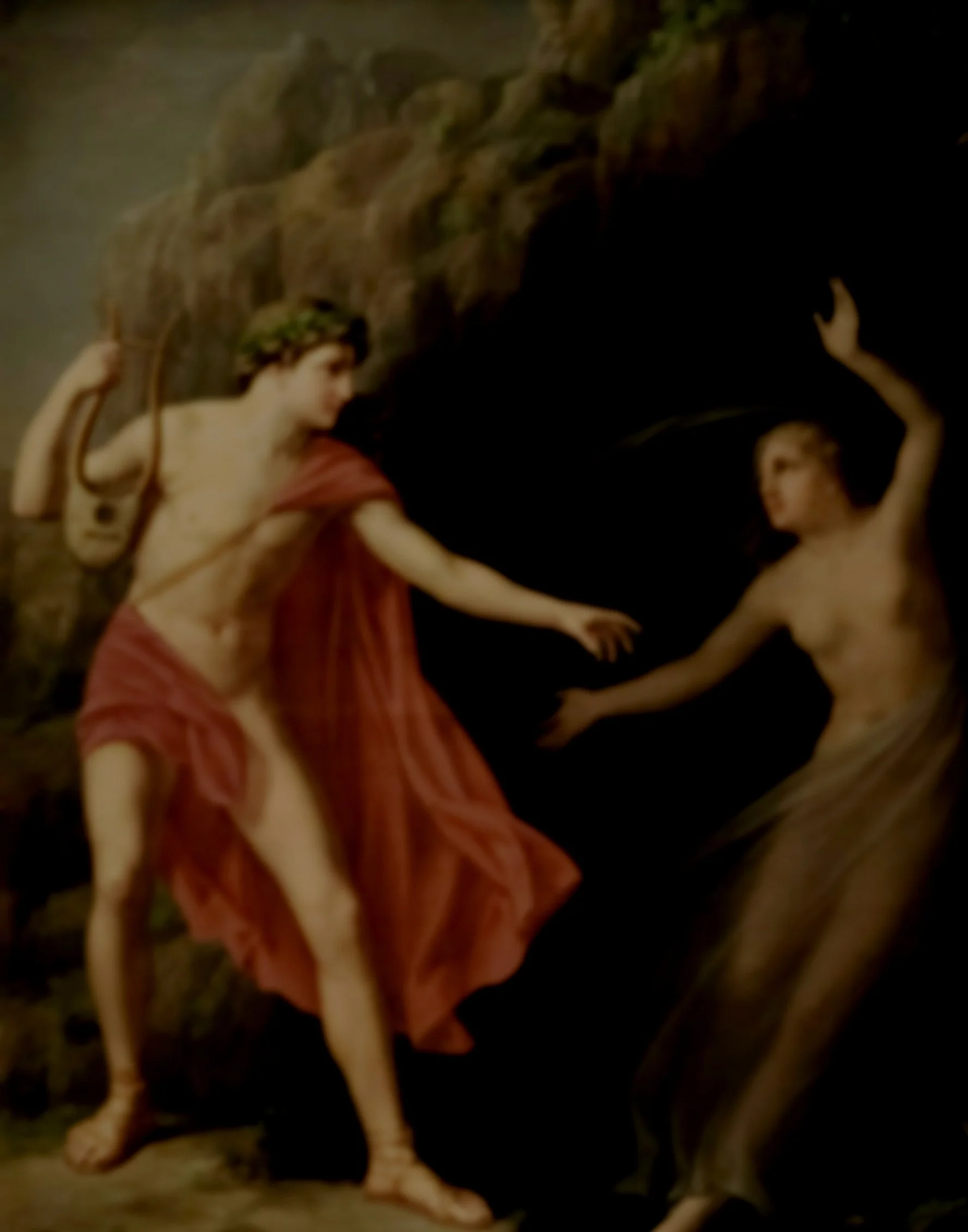
A melodious swing drifting through wind,
born of Dream and Calliope,
came to touch her delicate cheeks,
wipe the tears from her face,
and meet the divine—
Eurydice’s soul.
A blush brushes the surface
of her tender skin,
revealing the soft fall of young
love.
A first love.
An only love.
Something so rare, so unseen—
untouched,
uncanny upon Gaia,
as though it could not possibly
be.
He plays beautifully at their union,
her movements finessed with every note.
She dances with the air,
disappearing into each pluck,
each ping, each sound—
into the trees.
Consent begins to dissolve.
With the sway of hips
against the long blades of grass,
the crowd moves hypnotically
and suddenly forgets
how to see.
The music forgets how to sound.
Eurydice realizes she has lost herself
in the arms of a strange man.
He lifts her—
eyes hungrily grazing her body.
What do you wan—
Before the thought can finish forming,
he lowers his face.
Thunder folds into her,
shaking her sense of place.
He whispers,
to know your ache.
The earth holds its breath.
Suddenly—
as quickly as the stranger takes Eurydice,
a snake bites her ankle.
She screams.
The crowd regains its sight.
Orpheus hears her cries.
When she is found,
the stranger has vanished.
Eurydice is dead.
The snake coils beside her,
as if waiting—
guarding her body,
keeping her unharmed,
though it was
the very thing that killed her.
It watches Orpheus as it slithers away,
its stare almost threatening,
almost judging,
as Eurydice is slowly dragged
into the Underworld.
Orpheus travels past the Styx,
into dark, murky crevices
where he meets
Hades and Persephone—
against their will.
He petitions them,
begging for the love of his life
to be returned
with one song
to pierce Hades’ unrelenting dark.
With Persephone’s persuasion,
Hades agrees.
The lyre plays.
Orpheus sings.
The Underworld fills with light—
a glory known only to Olympus,
if only for a moment.
Moved by feelings long unfelt,
they grant him his love
under one condition.
Hades smiles gently at Persephone,
wipes the tear from her face,
remembering the years of life,
the pain endured—
all that she endured.
Her resilience.
“As you wish, my love,” he says,
pressing her warm, floral hand
to his cold lips.
She turns to Orpheus.
“Eurydice is yours, my dear boy.
I have placed her behind you.
Do. Not. Turn. Around.
You will hear her.
You will feel her.
You will want to look back.
Don’t.
Don’t even speak to her.
Your love brought you here—
against everything.
With a lyre and song,
you moved us like moons pull tides.
If you fought darkness to reach her,
you can walk through it with her,
knowing the only way to protect her
is to look toward the light—
toward Gaia.
You must trust it.
You must trust her.
Trust love.”
He nods.
The Underworld opens.
Something—
someone—
takes his hand.
A cold touch.
(Be.)
He shivers and walks forward,
holding the hand behind him.
Don’t look back.
The light of Gaia is near,
but the path is violent, mischievous.
“Orpheus, why won’t you talk to me?”
“Can’t you hear me?”
“Please— I’m afraid.”
He cannot.
He will not.
Not until he is out.
Not until he is free.
Yet with every step,
his spirit aches—
because it sounds like her,
feels like her,
smells like her.
It is Eurydice.
Her hand is cold.
She is afraid.
They are so close.
What if—
just once—
he looked?
To see if she was whole.
To know it was truly her.
To kiss her once.
To tell her he loved her.
Grass brushes their feet.
The exit nears.
Her hand grows warm.
“My love…” she sobs.
He turns.
Reaching for the tear on her cheek—
She is gone.
He gasps.
Breath fractures.
Panic.
(Be.)
Orpheus walks on,
propelled by shock,
burdened by pain—
losing the only woman he loved
not to fate,
but to disbelief.
He forgot her trust.
Her faith.
She never spoke.
Never questioned.
She followed.
Held his hand.
Closed her eyes.
Let herself be guided—
as instructed.
“You have to trust him.
That love.”
(Believe.)
She did.
Orpheus will never know
how deeply she loved him.
How completely she trusted.
He will only know devastation—
born of immaturity, insecurity,
and the need to see.
Something in the darkness
he should have already known
was as real as the hand
touching him.
(Believe.)
He will let others numb him,
disembody him,
to dull the pain of love lost.
But nothing will sever him
from the love he failed—
his sweet Eurydice.
Orpheus walks on.
Not forward—
but emptied.
The world receives him again,
grass underfoot,
sun on skin,
life continuing as if nothing sacred
has been broken.
But something has.
Inside him,
the music rots,
spoiling down from his skin
into the soil,
seeping into the depths,
playing its mourning songs
into the Underworld—
where Eurydice cries her loss
in betrayal
against Persephone’s kind bosom.
Above,
Orpheus tells himself stories—
that love was cruel,
that gods are tricksters,
that Eurydice slipped because she was weak,
because fate is careless,
because the world conspires.
Anything
but the truth:
He did not trust her.
He begins to fracture.
First, the song leaves him.
Then the will to touch.
Then the want to live among bodies.
He wanders.
He refuses women.
Refuses warmth.
Refuses flesh.
He speaks only to trees,
to stone,
to absence.
And absence answers nothing.
They come for him quietly.
Hands that are not divine,
not merciful—
but human.
They do not hate him.
They do not love him.
They tear.
Arms first—
the hands that once played the lyre,
that once held Eurydice’s
without ever feeling her trust.
They rip them away.
He screams,
but the sound means nothing now.
His chest is split—
the place where belief should have lived,
opened and emptied.
His legs are taken—
the legs that walked toward light
but stopped short,
that chose sight over faith.
Piece by piece,
his body is unmade.
Yet—
he does not die.
What remains
is his head.
Eyes intact.
Mouth intact.
Memory intact.
Still thinking.
Still knowing.
Still remembering
the warmth of her hand
just before it vanished.
The river carries him.
He cannot close his eyes.
He cannot forget.
He sings no more—
but his mind sings endlessly,
replaying the moment
he turned.
The blade of realization
cuts forever:
She trusted him completely.
She did everything right.
He failed her.
Eternity is not fire.
It is awareness.
To exist without a body—
without hands to create,
without arms to hold,
without a heart to justify—
only a mouth
to repeat the truth.
Only a head
to know
that love was offered fully
and refused.
And the world listens
as Orpheus floats,
still alive,
still conscious—
a monument
to disbelief.
Author’s Note: I began thinking about this version of Orpheus and Eurydice after watching The Sandman. It made me reflect on how many versions of Greek mythology exist, and how we’re always—consciously or not—choosing which ones we believe in most. This poem is a blending of the versions I could stand behind.
One of the things I’ve always loved is the story of Dream and Calliope creating Orpheus. In The Sandman, Dream technically could have returned Eurydice to his son—but doing so would have violated every code he lives by and ignited divine infighting and war. And ultimately, that fight was never Dream’s. It was Orpheus’s.
Orpheus asking his father to fix what he lost has always struck me as childish—less about love, more about unresolved power and entitlement. There’s a reason I didn’t include that aspect here.
I also wanted to reframe the snake.
Snakes are often given a bad reputation, but in my culture they represent strength, fertility, and the connection between realms. To make the snake purely evil never made sense to me. In this version, the snake is Gaia—protecting Eurydice, not harming her.
Gaia has watched Zeus take women without their consent again and again. This time, she intervenes. Death is not punishment here; it is removal. Protection. A chance.
With Hades and Persephone, Eurydice has that chance.
The version of Hades and Persephone I draw from is inspired by Lore Olympus: a relationship rooted in devotion, patience, and trust. Hades could have made the decision himself—but instead, he defers to Persephone, because he understands that love is proven not through control, but through trust.
That trust is the test Orpheus fails.
In almost every version of this myth, Orpheus never makes it out with Eurydice. Something always compels him to turn around—to doubt her, to doubt himself, to doubt love. That repetition raises the question: Was it ever true love at all?
This poem is my attempt to answer that—by giving Eurydice her own truth.
She trusted.
She loved.
She stayed.
The gods were not cruel.
He was simply not ready. - Evy Gonzalez Ronceria